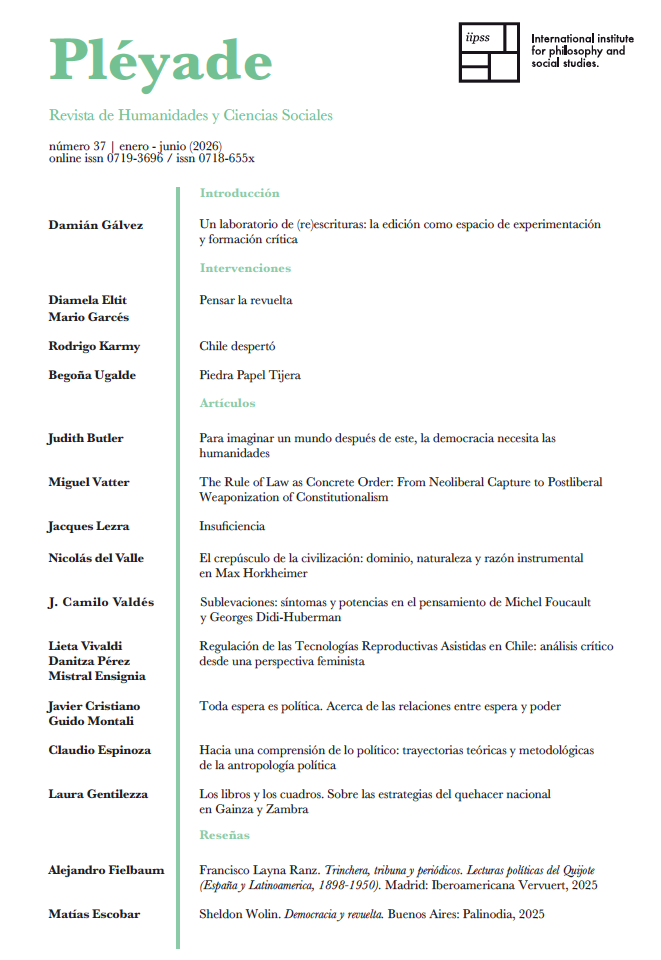
Regulation of Assisted Reproductive Technologies in Chile: A critical analysis from a feminist perspective
 Lieta Vivaldi Macho
- Danitza Pérez Cáceres
- Mistral Ensignia Fries
Published 2026-07-31
Keywords
- Tecnologías de reproducción asistida,
- autonomía reproductiva,
- justicia reproductiva,
- teorías feministas,
- regulación jurídica
How to Cite
Copyright (c) 2026 Lieta Vivaldi Macho, Danitza Pérez Cáceres, Mistral Ensignia Fries

This work is licensed under a Creative Commons Attribution-NonCommercial 4.0 International License.
Abstract
Assisted Reproductive Technologies (ART) are medical biotechnologies that assist in human This article critically examines the regulation of Assisted Reproductive Technologies (ART) in Chile from a feminist perspective. It argues that the absence of comprehensive legislation generates legal and ethical gaps that deepen inequalities based on gender, class, and economic access. Drawing on an interdisciplinary framework that integrates law, bioethics, and feminist theory, the analysis explores how ART challenges the principles of reproductive autonomy and reproductive justice. The study reviews the current legal framework in Chile and Latin America, including legislative initiatives, judicial decisions, and international human rights standards, highlighting the relevance of the Artavia Murillo v. Costa Rica ruling of the Inter-American Court of Human Rights. Furthermore, it discusses the intersection between assisted reproduction, neoliberal policies, and the commodification of life, underlining the risks of reproductive stratification. The article contends that a holistic regulatory framework must ensure equitable access, safeguard autonomy, and prevent discrimination against women and pregnant persons. Finally, it stresses the importance of fostering an informed public debate and implementing gender-sensitive public policies to protect sexual and reproductive rights in the context of an increasing demand for assisted reproductive technologies.