
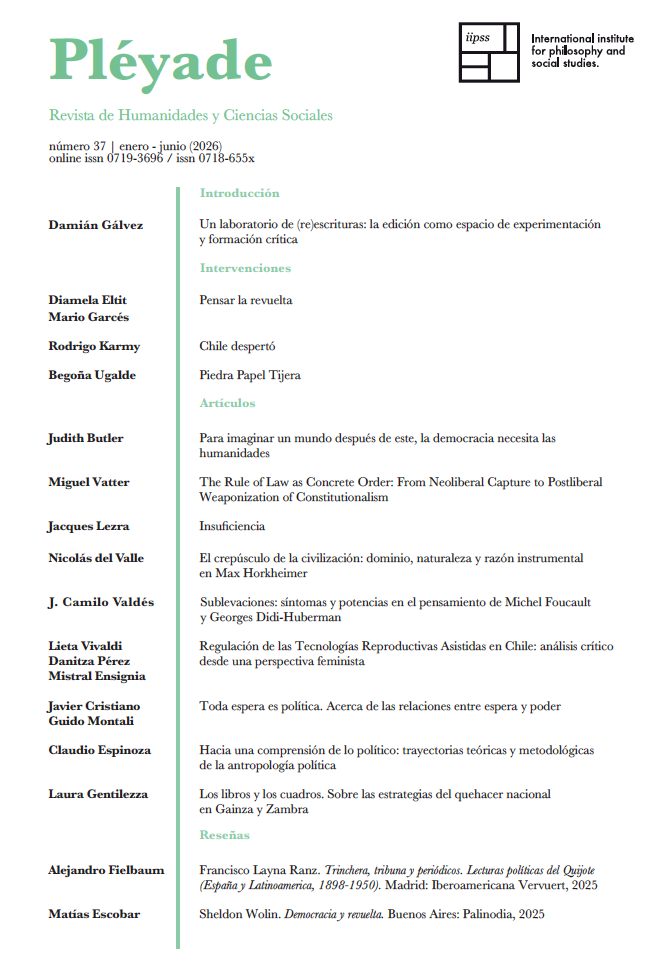
Published 2026-07-31
Keywords
- Reason,
- (in)sufficiency,
- mediation,
- (in)determination,
- Heidegger
How to Cite
Copyright (c) 2026 Jacques Lezra

This work is licensed under a Creative Commons Attribution-NonCommercial 4.0 International License.
Abstract
The essay seeks to define, and to show what is to be achieved by constructing, a principle of insufficient reason for thinking (concerning current states of affairs, crises, matters social, environmental, and political that seem outrageously excessive; as well as thinking “abstractly,” if such is conceivable). What is the structure of this “principle,” what is its philosophical genealogy, what sorts of judgments does it make possible, what sorts does it exclude? In particular, what relation will the principle of reason’s insufficiency have to indeterminate mediation? The matter is approached through an analysis of the shift in Heidegger’s argument from the years of Being and Time, between 1927-8, to the lectures on Satz vom Grund of 1956, concerning the first of the three great principles —the principle of sufficient reason— which joins the principle of contradiction or identity, the principle of the excluded middle to form the logical ground of Western metaphysics.